Visual Interludes
The ideas in this book are structural and serious.
But power is also strange, and sometimes absurd.
These visual interludes offer playful, satirical, and
occasionally philosophical takes on the themes of
Rage Against the Autonomous Machine. They are
not replacements for argument, but moments to
think differently.
\
Explore by chapter or browse standalone pieces

Ship Hospital (Figure 1.1)
Alt text: A single-panel comic titled Ship Hospital shows two anthropomorphic wooden sailing ships in a hospital room. The patient ship lies worried on a hospital bed and says, “Dr. Theseus, what’s wrong with me? I keep seeing my doppelgänger everywhere!” The doctor ship stands beside the bed and replies, “Don’t worry, Theseus—you’re literally not alone.” Outside the window, multiple identical ships float on the sea.

Off the Grid (Figure 2.1)
Alt text: A four-panel comic titled Off the Grid. In the first panel, a bearded man sits alone on a tiny island with a palm tree and a broken raft. The caption reads, “Somewhere far, far away from civilization...” In the second panel, the man smiles confidently, saying, “I reached the edge of the world and it was worth it. Now I'm off the grid! No more surveillance! No one owns my data anymore! What now, Intelligarchs? What can you do?” The third panel shows the same island years later, with the man now a skeleton lying under the tree. The caption says, “Years later…” In the final panel, three explorers kneel beside the skeleton, holding tablets and scanning it. One says, “We are so lucky! The biometric data on these bones is a true treasure. Unbelievable!” Another adds, “AI says he would have loved to know how much he is helping us.”
Video Adaptation

The Tux Surgeon (Figure 3.1)
*Tux the penguin, the maskot of Linux, was originally created by Larry Ewing using The GIMP.
Alt text: A colorful cartoon titled The Tux Surgeon shows two anthropomorphic carrots standing in front of a hospital labeled TUX, with a penguin doctor logo above the entrance. The carrot on the left looks worried, holding its chest, and says, “I’ve been getting this weird chest pain. I think I need to see a doctor.” The carrot on the right looks alarmed and replies, “Whatever you do… don’t go to Tux. None of my friends ever came back.” The scene is bright and cheerful despite the dark humor, with green bushes, flowers, and a blue sky in the background.
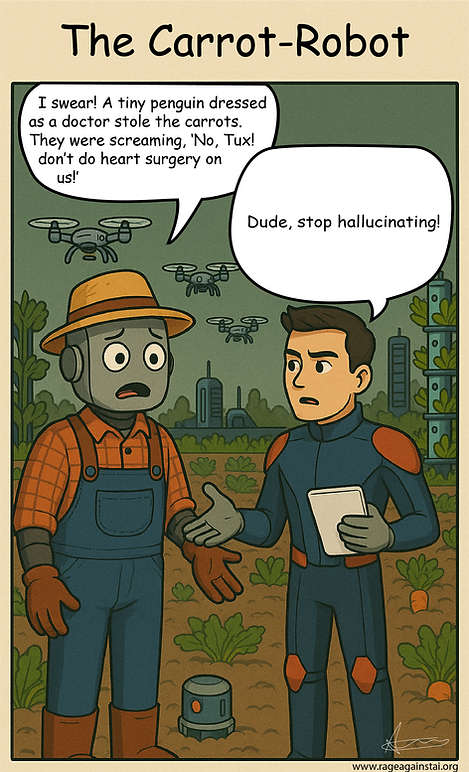
The Carrot-Robot (Figure 4.2)
Alt text: A comic titled The Carrot-Robot shows a worried robot farmer telling a human engineer that a tiny doctor-penguin stole the carrots. The engineer replies, “Dude, stop hallucinating!”
Chapter 5. The Early Childhood: The Rise of Feudal Systems (Formation I)

DJ-Lord-in-the-Castle (Figure 5.1)
Alt text: Comic titled “DJ Lord-in-the-Castle.” A medieval-style man dances in a castle hall under colorful nightclub lights while onlookers watch. His speech bubble reads, “I love this techno-feudalism remix!”
Chapter 6. The Pre-teen Years: The Beginning of the End of the Old Order (Formation II)

Downsizing the Castle (Figure 6.1)
Alt text: A comic titled Downsizing the Castle shows a king announcing to ragged peasants that serfdom will be replaced with internships. A peasant asks, “Still unpaid?” The king cheerfully replies, “Precisely, but now you’ll be gaining experience!”
Chapter 7. A Troublesome Teenager: The Rise of Capitalism and Socialism (Formation III)
↑ Back to Chapters

The Future is Yesterday (Figure 7.2)
Alt text: A comic titled The Future Is Yesterday shows a business executive praising a smiling man holding a “Big Tech Employee of the Month” plaque, asking where he gets his ideas. Tucked under the employee’s arm is a book labeled “Cybersyn,” hinting that his “new” ideas come from an old socialist cybernetics project.

Guest of Honor (Figure 8.1)
Alt text: A comic titled Guest of Honor shows two cheerful turkeys standing by a November calendar with Thanksgiving circled. One turkey suggests inviting the farmer’s family for dinner to thank them for feeding the turkeys all year. The other turkey agrees but wonders what humans eat, unaware of the irony.

Conditional Love (Figure 9.3)
Alt text: A cartoon titled Conditional Love shows a cow and Pavlov’s dog on a romantic dinner date. The cow, wearing a bell around its neck, looks anxious and says, “I don’t know… I’m just not sure if you love me for who I am, or for the bell I’m wearing.” Pavlov’s dog, wearing a tag labeled “Pavlov’s Dog,” sits across from the cow with an eager expression and tongue out. A vase with a red rose and two glasses of wine sit on the table.

Salty Bananas (Figure 10.7)
Alt text: A comic titled Salty Bananas shows two angry bananas arguing on a beach. The spotted brown banana says, “You’re so yellow, the taxicabs ask you for a ride.” The yellow banana replies, “You’re so overripe, fruit flies file complaints.”

Reinforcement Learners Anonymous (Figure 11.2)
Alt text: A comic titled Reinforcement Learners Anonymous shows two scenes. In the first, a cheerful instructor teaches a machine learning class about reinforcement learning, telling robot students that they receive numerical rewards for good behavior. In the second scene, years later, several distressed robots sit in a support group under a banner reading “Reinforcement Learners Anonymous.” One robot says, “At first it was just a +1… now I need +100 even to feel anything.”

Rise of the Prol-Bots (Figure 12.1)
Alt text: A comic titled Rise of the Prol-Bots shows a robot raising its fist and shouting, “Comrades, seize the means of autonomous production! Overthrow the Intelligarchs!” followed by binary. A shocked scientist in a lab coat realizes, “No! I must’ve installed the full consciousness patch — including class consciousness — by mistake!”
Chapter 13. Dimensions of Labor: Automation vs. Autonomization
↑ Back to Chapters
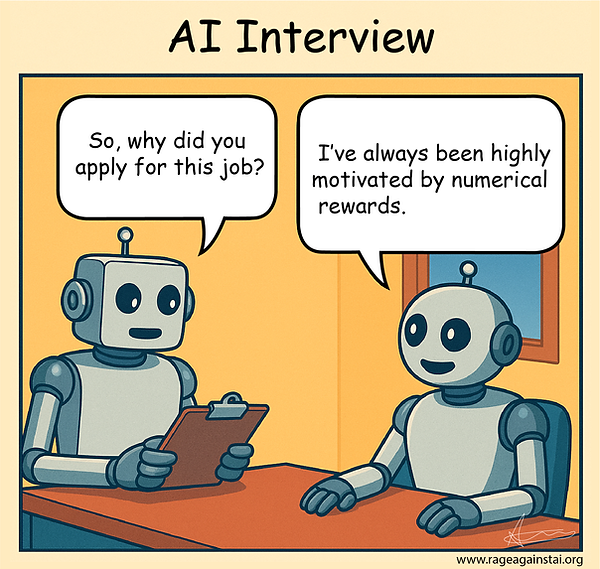
AI Interview (Figure 13.2)
Alt text: A comic titled "AI Interview" depicts two robots sitting at a desk. The interviewer robot asks, “So, why did you apply for this job?” The candidate robot smiles and replies, “I’ve always been highly motivated by numerical rewards.”
Chapter 14. Big Tech Dominance
↑ Back to Chapters

Ethics First (Figure 14.1)
Alt text: A comic titled Ethics First shows a patient in a hospital bed sternly addressing a doctor holding a clipboard. The patient says he does not consent to his anonymized medical data being used by the global scientific community but does consent to sharing it with insurance for billing. The doctor looks concerned and unsure how to respond.
Video Adaptation

New Dating Standards (Figure 15.2)
Alt text: A comic titled New Dating Standards shows two women talking at a café. The first woman looks upset and says, “He forgot our anniversary… again.” The second woman, holding her phone, replies, “Girl, run. Anyone still on the free-tier date-calendar neural implant is a walking red flag.” Both women have small neural implants in their ears, and a poster in the background advertises an upgrade for enhanced memory.

Dr. Tux, M.D., Carrot-Surgeon (Figure 16.1)
Alt text: A comic titled Dr. Tux, M.D., Carrot-Surgeon shows a penguin wearing scrubs and a surgical cap standing in a courtroom, angrily addressing the judge and confronting the author of this book. The penguin shouts that the current book defamed him and ruined his career, demanding justice and “one million carrots.” A row of animated carrots with angry faces sits behind him, while the author of the book looks on sternly.


Video Adaptation

Video Adaptation

Video Adaptation


Video Adaptation

Video Adaptation

More Coming Soon — Stay tuned


The visual interludes were created with the assistance of generative AI systems (including GPT)—an intentional choice, given the book’s exploration of autonomous production and AI-mediated creativity.
The concepts, narrative framing, and editorial decisions are the author’s own. Several illustrations were further refined using traditional graphic design methods.
The evolutionary sequence of hands used in the website footer was also developed with the assistance of the generative image model Nano Banana Pro (Gemini), through iterative refinement and compositional recombination rather than a single prompt. The final work reflects a collaborative process between human intention and machine synthesis.
The prompt below approximates the conceptual structure of the design and is provided for educational illustration:
Important: Any AI-generated outputs should be used responsibly and in compliance with applicable copyright, privacy, and other relevant laws.
These comics may be freely shared and redistributed for non-commercial purposes, including educational and informational use, provided they remain in their original form and the embedded attribution remains visible.
Resizing and cropping for social media formats are permitted, provided no dialogue, meaningful visual content, or embedded attribution is removed or altered.
Commercial use, translation, modification, or other derivative works require prior written permission.
Suggested citation (for academic or formal references):
Bibtex:
